오늘의 Discussion Items
1. Being Different
Despereaux breaks many mouse rules. Does this make him a bad mouse, or could the rules themselves be wrong?
Think about reading instead of eating books, music, humans, Princess Pea, and the Mouse Council. When is it acceptable to break a rule?
Rule은 언제나 지켜야 할까? 좋은 Rule 과 Bad Rule 이 있는걸까? 있다면 어떤 Rule 이 좋은걸까? 아이들은 좋은 Rule은 모두를 위한 Rule 이라고 답했다. 모두의 **을 위한 Rule 로 확장시켜보았다. 모두의 safety, 모두의 benefit, 모두의 happiness 등등.
Model answer: Despereaux breaks the rules, but not to hurt anyone. He follows curiosity, love, and his sense of what is right. The Mouse Council treats difference as danger. The story suggests that obeying a rule is not always the same as doing the right thing; courage may sometimes mean questioning an unfair rule.
Listen for: rules vs morality • conformity vs individuality • brave and foolish can coexist
Push further: Are rules necessary? / What if everyone broke rules they disliked? / Is Despereaux brave, foolish, or both?
2. Is Roscuro Really Evil?
Is Roscuro a bad character, or does he become bad because he is hurt?
Understanding someone is not the same as excusing them. What is the difference?
Could Princess Pea’s reaction have changed the whole story?
Model answer: Roscuro does harmful things, so his actions are wrong, but he is not simply evil. He is attracted to light and beauty, unlike Botticelli. After rejection and humiliation, his longing turns into anger and revenge. His pain explains his choices without excusing them. He shows that “light” and “darkness” can exist in the same character.
Listen for: explanation ≠ excuse • hurt can become revenge • contrast with Botticelli
Push further: Does being hurt reduce responsibility? / Does understanding lead to forgiveness? / Which is more dangerous: cruelty or hurt turned into cruelty?
앞서 Mig 의 Mock Trial 을 할 때부터 아이들은 사실 Roscuro는 나쁜 놈으로 정해놓고 있었다. 하지만 이 질문을 통해 Roscuro 라는 캐릭터에 대해서도 자세히 들여다 볼 수 있게 되었다. 그러다 앞선 1번질문과 2번질문을 연결시켜 레미제라블의 장발장 이야기가 나왔다.
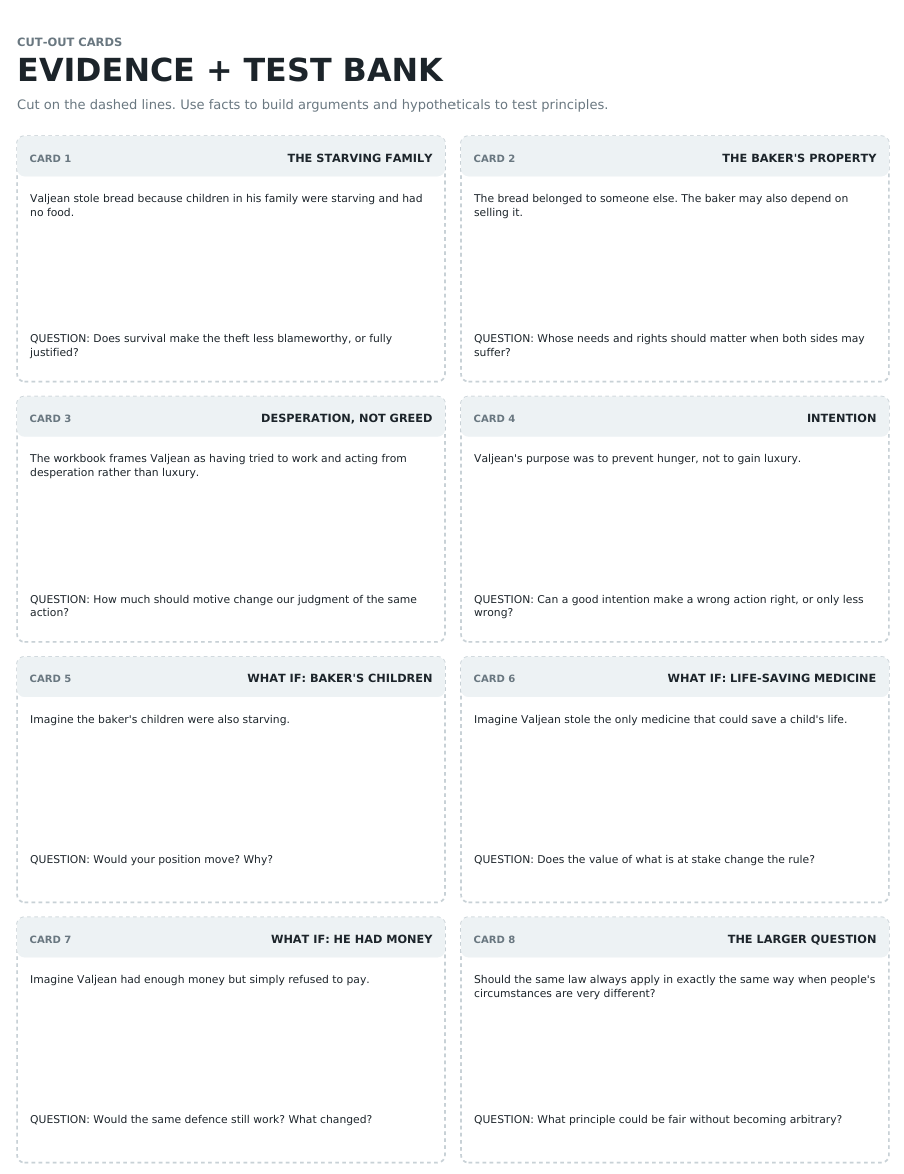
3. 그렇게 수업은 레미제라블로 연결되며, 레미제라블을 읽고 다른 상황, 다른 인물들이 나오지만 어떠한 공통점이 있는지, 어떠한 차이점이 있는지 어떠한 상황에서 인물들이 어떤 선택들을 하게 되는지에 대해 더 깊게 이야기 해보기로 한다.
3-1. Summary
Les Misérables
Les Misérables, written by Victor Hugo, is a novel about poverty, justice, love, forgiveness, and the possibility of personal change. The story mainly follows Jean Valjean, a man whose life is transformed by an act of mercy.
Jean Valjean is sent to prison after stealing a loaf of bread to feed his sister’s starving children. Because he repeatedly tries to escape, his sentence is extended, and he eventually spends nineteen years in prison. After his release, he is treated badly everywhere because he is an ex-convict. One night, however, a kind bishop named Bishop Myriel welcomes him into his home.
Valjean repays the bishop’s kindness by stealing his silverware. He is soon caught by the police and brought back. Instead of accusing him, the bishop tells the police that he gave the silver to Valjean. He even gives Valjean more silver and tells him to use it to become an honest man. Deeply moved by this unexpected mercy, Valjean decides to change his life.
Years later, Valjean lives under the name Monsieur Madeleine. He becomes a successful businessman and a respected mayor who helps the poor. However, a strict police inspector named Javert begins to suspect that Madeleine is actually Jean Valjean. Javert strongly believes that criminals never truly change and that the law must always be obeyed.
One of Valjean’s factory workers is a poor woman named Fantine. She has a young daughter, Cosette, who is living with the cruel Thénardier family. Fantine loses her job and becomes desperately poor while trying to send money for Cosette. She eventually becomes seriously ill. Valjean promises Fantine that he will find Cosette and take care of her.
At the same time, another man is mistakenly arrested as Jean Valjean. Valjean knows that he could remain silent and protect his new life, but he cannot allow an innocent man to be punished in his place. He goes to court and reveals his true identity.
Fantine dies before she can see Cosette again. Valjean keeps his promise and rescues Cosette from the Thénardiers, who have treated her cruelly. He raises her as his own daughter and gives her the love and protection she has never had. Meanwhile, Javert continues to hunt Valjean.
As Cosette grows older, she falls in love with a young man named Marius. Marius is connected with a group of students who are fighting for political and social change in Paris. They build barricades in the streets and take part in an uprising against the government.
When Valjean learns that Cosette loves Marius, he goes to the barricades. There, he is given the chance to kill Javert, who has been captured as a spy. Instead, Valjean secretly releases him. Later, Marius is badly wounded, and Valjean carries him through the sewers of Paris to save his life.
Javert eventually meets Valjean again and has another chance to arrest him. However, he is deeply confused. Valjean, a former criminal, has shown him mercy and has repeatedly acted with courage and goodness. This challenges everything Javert believes about law, crime, and morality. Unable to accept that a criminal can become a good person, Javert takes his own life.
Marius and Cosette eventually marry. Valjean tells Marius about his criminal past and slowly distances himself from the couple because he fears that his past may harm Cosette’s happiness. At first, Marius misunderstands Valjean, but later he learns that Valjean was the person who saved his life.
Marius and Cosette rush to visit Valjean when he is close to death. Valjean is comforted to see Cosette happy and dies peacefully.
At its heart, Les Misérables asks difficult moral questions. Is obeying the law always the same as doing what is right? Can punishment truly change a person? Who is responsible for poverty and suffering? Can people genuinely change? Through the contrast between Jean Valjean and Javert, Victor Hugo suggests that mercy, compassion, and love can sometimes achieve what punishment cannot.
그래서 아이들과 다시 한번 Mock Trial 을 해보기로 했다. 사실 다소 지루하고 뻔할 수 있는 장발장 이야기와 장발장이 유죄냐 무죄 냐 보다는 아이들에게 다양한 시선과 접근을 하게 해 주는 질문들이 좋은 것 같다.
'엄마표 교육과 관련된 모든 정보' 카테고리의 다른 글
| 초등 엄마표 영어, 엄마표 홈스쿨링 수업자료 TWINKL (0) | 2026.09.09 |
|---|---|
| [교육] 내 아이에게 맞는 뉴질랜드 초등학교 고르기 (0) | 2026.09.01 |
| [원서읽기] The Tale of Despereaux (02) Mock Trial of Miggery Sow (0) | 2026.08.29 |
| [원서읽기] The Tale of Despereaux (01) 수업자료 및 토론주제 (0) | 2026.08.28 |
| [교육] 뉴질랜드 영어사교육 필수 정보! ICAS 시험 완전 정복 📘✨ (0) | 2025.05.11 |